


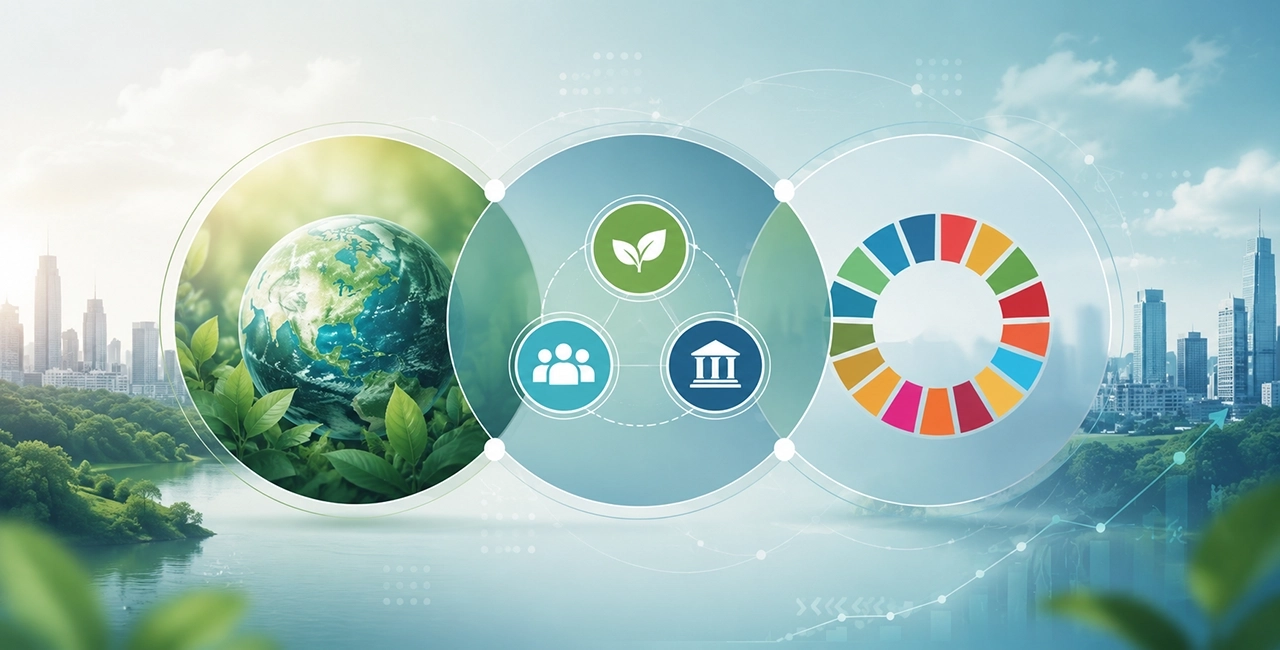
In many organizations, Sustainability, ESG, and SDGs are used as if they mean the same thing. In reality, each concept plays a different role. This article explains their difference in simple management language and shows why understanding them matters for decision-making, reporting, and sustainability alignment.
ESG, SDGs, and Sustainability: What Is the Difference for Managers?
1) The Real Problem
In management meetings, reports, presentations, and sustainability programs, three terms appear frequently: Sustainability, ESG, and SDGs.
They are often used interchangeably. ESG is sometimes treated as the same as sustainability. SDGs sometimes appear only as colorful icons in reports. Some organizations assume that a few environmental or social activities are enough to build a sustainability path.
But the key question is: if these concepts are not clearly understood, what exactly is the organization managing?
Conceptual confusion in sustainability is not only a language problem. It can lead to poor decisions, weak reporting, disconnected indicators, and fragmented programs.
2) A Common Organizational Mistake
A common mistake is treating Sustainability, ESG, and SDGs as the same thing.
In this approach:
- Sustainability is reduced to a few environmental activities
- ESG becomes a form or reporting exercise
- SDGs become colorful icons in slides
- Indicators are selected without connection to management decisions
- Different teams do not share the same understanding of sustainability
The result is that the organization talks about sustainability, but it does not have a clear path for managing, measuring, and making decisions about it.
3) What Does Sustainability Mean?
Sustainability is the broader concept. It means that an organization can create long-term value, understand its impacts, manage future risks, and align today’s decisions with a defensible future.
Sustainability is not only about the environment. It can include:
- The organization’s environmental impact
- Health, safety, and quality of life for employees and communities
- Resource and energy management
- Governance and decision transparency
- Organizational resilience against future risks
- Learning, competency, and long-term capability
- Sustainable value creation for stakeholders
In simple terms, Sustainability answers this question: how can the organization make decisions today without weakening its own future, society, or the environment?
4) What Does ESG Mean?
ESG stands for Environmental, Social, and Governance.
ESG focuses on how an organization’s performance and risks are identified, measured, managed, and reported across three main areas:
- Environmental: environmental impacts, energy, waste, emissions, resource use, and climate-related issues
- Social: employees, safety, health, human rights, communities, supply chains, and social impacts
- Governance: transparency, ethics, decision structures, compliance, accountability, and risk management
Therefore, ESG is more about the measurement, management, and reporting language for part of sustainability. If Sustainability is the broader direction, ESG is one important framework for seeing and measuring that direction.
5) What Do SDGs Mean?
SDGs refer to the United Nations Sustainable Development Goals. They provide a global framework for sustainable development and cover areas such as poverty, health, education, water, energy, decent work, innovation, reduced inequalities, responsible consumption, and climate action.
SDGs help organizations connect their activities and impacts to a global development agenda.
But an important point must be clear: SDGs should not become only a set of colorful icons in a report.
If an organization claims alignment with an SDG, it should be able to show:
- How that goal is connected to the organization’s activities
- What real impact has been created
- Which KPI shows that impact
- Which decision has changed because of this goal
- How this alignment appears in the operational plan
6) A Simple Management Difference Between the Three
A practical way to understand the difference is this:
- Sustainability: the broader logic of long-term value creation and responsible decision-making
- ESG: a framework for measuring, managing, and reporting risks and performance in environmental, social, and governance areas
- SDGs: a global framework for aligning organizational impacts with sustainable development goals
In very simple words:
- Sustainability explains the long-term path
- ESG explains what should be measured and managed
- SDGs explain which global goals the path can support
7) The Managerial Translation (So What?)
For managers, the difference between these concepts matters when decisions need to be made.
If the concepts are confused:
- Reports may look polished but create little impact
- Indicators may be selected but fail to support decisions
- Global goals may appear in reports but not in operational plans
- ESG may become a form-filling exercise instead of a management system
- Sustainability may remain disconnected from strategy, risk, and performance
Managers do not need complex definitions. They need a shared language. A shared language helps the organization understand what should be managed, what should be measured, and what should be turned into decisions.
8) A Simple Organizational Example
Imagine an organization wants to reduce its energy consumption.
From a Sustainability perspective, this action is part of long-term value creation, risk reduction, and resource management.
From an ESG perspective, it belongs mainly to the Environmental area and should be measured through indicators such as energy consumption, energy intensity, energy cost, or related emissions.
From an SDG perspective, it can be connected to goals such as affordable and clean energy, responsible consumption and production, or climate action.
But real value is created when these three perspectives are connected to management decisions:
- Which process should be improved?
- Which investment should be prioritized?
- Which behavior should change?
- Which KPI should appear in the management dashboard?
- Which result should be monitored in the next period?
9) The Role of QHSE in Connecting These Concepts
In many organizations, QHSE can become a practical bridge between Sustainability, ESG, and SDGs.
The reason is clear: QHSE already deals with quality, health, safety, environment, risk, compliance, data, and performance.
For example:
- Employee safety connects to the Social dimension of ESG
- Waste and energy management connect to the Environmental dimension
- Transparent incident reporting and corrective actions connect to Governance
- Training and competency connect to sustainable performance
- QHSE dashboards can turn sustainability data into management decisions
This means QHSE can help move sustainability from slogans and reports into systems, data, and decisions.
10) Decision-Focused Summary
Sustainability, ESG, and SDGs are related, but they are not the same.
When an organization understands the difference:
- It sees Sustainability as the broader path for long-term value creation
- It uses ESG as a framework for managing and reporting risks and performance
- It uses SDGs as a map for aligning organizational impacts with global goals
- It selects better indicators
- It makes reports more defensible
- It connects management decisions to the organization’s future, society, and the environment
The main problem is not that organizations do not use these words. The problem is that these words are not always translated into decisions, KPIs, risks, and operational pathways.
Sustainability becomes real when it moves from words to systems, from reports to decisions, and from goals to execution paths.
FAQ
Is ESG the same as Sustainability?
No. Sustainability is the broader concept and refers to long-term value creation and responsible decision-making. ESG is an important framework for measuring, managing, and reporting part of sustainability.
Are SDGs useful for companies?
Yes, but companies need to connect SDGs to real impacts, KPIs, operational plans, and management decisions. Using SDG icons alone is not enough.
Which concept should an organization start with?
A good starting point is to clarify the organization’s sustainability issue and long-term value path first, then use ESG and SDGs for measurement, reporting, and alignment.
Soft CTA
If ESG, SDGs, and Sustainability in your organization are still mostly used as reports, forms, or disconnected terms, the starting point may be a shared language and alignment roadmap that connects them to KPIs, risk, data, and management decisions.