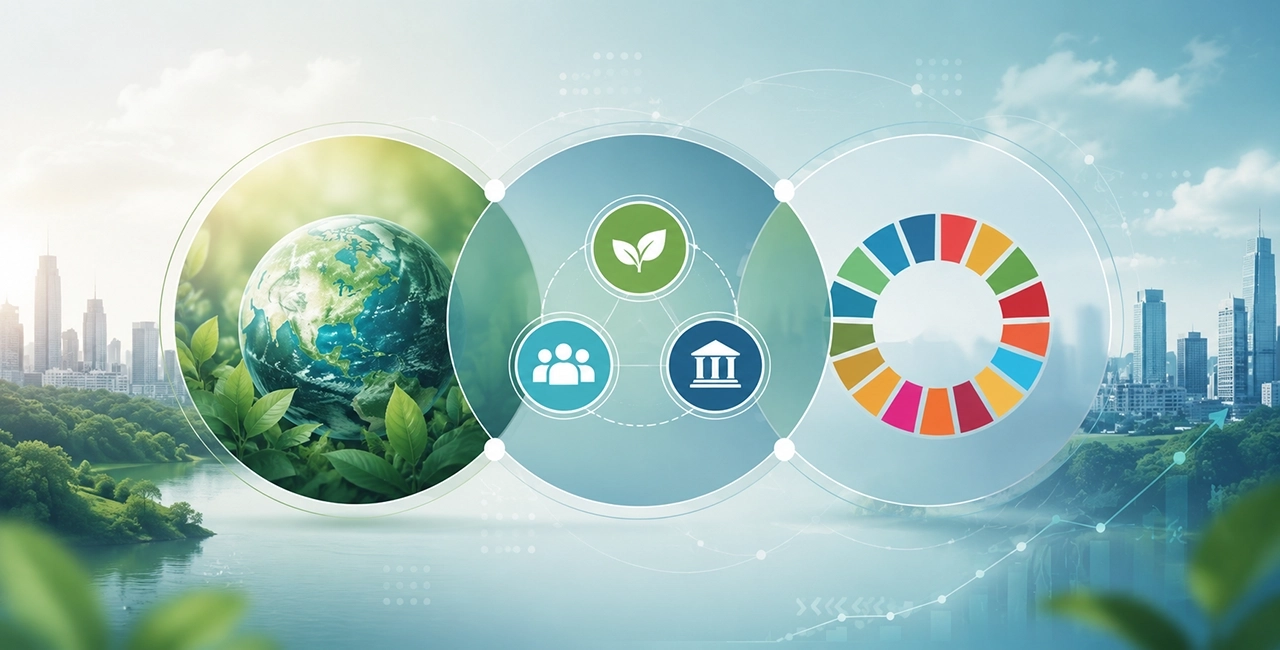



In many organizations, sustainability appears in reports, campaigns, social responsibility programs, or environmental initiatives. But sustainability creates real value only when it is aligned with decisions, performance indicators, risks, resources, and the future direction of the organization.
What Is Organizational Sustainability and Why Does It Fail Without Alignment?
1) The Real Problem
Many organizations talk about sustainability today. Some publish sustainability reports. Some run environmental initiatives. Some invest in social responsibility. Others try to connect their work with ESG, SDGs, or long-term value creation.
But one important question remains: has sustainability actually entered the organization’s decision-making system?
If the answer is no, sustainability may become a decorative layer. It may appear in reports, presentations, branding messages, and public statements, but it does not significantly influence real decisions.
The real problem is not that organizations ignore sustainability. The problem is that sustainability is often not aligned with performance, risk, decision-making, and the future path of the organization.
2) A Common Organizational Mistake
A common mistake is treating sustainability as a separate activity.
In this approach, sustainability is often limited to one of the following:
- An annual report
- An environmental project
- A social responsibility activity
- A branding campaign
- A response to external requirements
- A set of indicators disconnected from core management
This creates a separation between sustainability and the business.
The organization may speak about sustainability, but its key decisions may still be driven mainly by short-term targets, operational pressure, or isolated compliance requirements.
3) Redefining Organizational Sustainability
Organizational sustainability is not only about reducing energy consumption, supporting communities, or meeting environmental requirements.
Organizational sustainability means the ability of an organization to create long-term value, manage its impacts, reduce long-term risks, and align today’s decisions with a defensible future.
In this definition, sustainability is not a separate department. It is a management logic.
It requires the organization to answer questions such as:
- How does today’s decision affect the future of the organization?
- How does organizational growth affect people, society, the environment, and stakeholders?
- Which long-term risks are not yet visible in daily decisions?
- Do performance indicators only measure short-term output, or do they also reflect sustainable value?
- Is sustainability connected to strategy, operations, learning, and data?
4) The Managerial Translation (So What?)
From a management perspective, sustainability matters when it becomes part of decision-making.
Managers do not make decisions based on abstract concepts. They need to know:
- What needs to change?
- Which priority matters most?
- Which risk should be seen earlier?
- Which indicator should be monitored?
- Where should resources be moved?
- Which action creates real long-term value?
Sustainability enters management when it can be translated into the language of decisions.
If resource consumption is only reported, sustainability remains descriptive. If resource consumption is connected to cost, risk, productivity, and investment decisions, sustainability becomes managerial.
5) Why Alignment Matters
Sustainability without alignment often fails because it remains disconnected from the core system of the organization.
Alignment means that sustainability is meaningfully connected to:
- Strategy
- Objectives and KPIs
- Risk management
- Operational processes
- Investment decisions
- Organizational culture and behavior
- Learning and competency development
- Data, reporting, and management dashboards
- Stakeholder expectations
- The future growth path of the organization
Without this connection, sustainability remains on the margins. The organization may perform several positive activities, but it cannot clearly show how those activities affect performance, risk, decisions, or long-term value.
6) Signs That Sustainability Is Not Aligned
Several signs show that sustainability is not yet aligned within the organization:
- Sustainability appears only in reports
- Indicators are not connected to decisions
- Teams do not share the same meaning
- Sustainability goals conflict with operational goals
- Data exists, but insight does not
If sustainability is discussed mainly during reporting, audits, or management presentations, it has probably not entered daily decision-making.
An organization may have sustainability indicators. But if it is not clear which decision each indicator supports, the indicators may become decorative.
7) How Aligned Sustainability Can Be Built
To move sustainability beyond slogans and reports, organizations need a staged approach.
A practical path may include the following steps:
- Define the real sustainability issue
- Identify stakeholders and impacts
- Set material and strategic priorities
- Connect sustainability to KPIs and risk
- Design a staged roadmap
- Monitor, learn, and adjust the path
Without a clear issue, sustainability becomes a set of scattered activities. Without connection to KPIs and risk, sustainability cannot become manageable or defensible.
8) The Connection Between Sustainability, QHSE, Data, and Learning
Sustainability becomes stronger when it is connected to other organizational systems.
In many organizations, QHSE can be a strong bridge to sustainability because it already deals with quality, health, safety, environment, risk, performance, and compliance.
At the same time, sustainability cannot become defensible without data. The organization needs to show:
- What has changed?
- Which action has worked?
- Which risk has decreased?
- Which indicator has improved or deteriorated?
- What decision should be made based on the evidence?
Learning and competency also play a critical role. If people, managers, and teams do not have the required capability and behavior, sustainability remains only a policy statement.
Real sustainability emerges at the intersection of sustainability, data, learning, and decision-making.
9) Sustainability as a Path, Not a Project
Another common mistake is treating sustainability as a project with a clear start and end.
In reality, sustainability is more like a management pathway:
- It starts with understanding the current state
- It continues with prioritization
- It connects to KPIs and decisions
- It is tested through implementation
- It is monitored through data
- It improves through learning
- It is redesigned as conditions change
That is why sustainability needs a roadmap, not only an activity plan.
10) Decision-Focused Summary
Organizational sustainability becomes meaningful when it moves beyond reports, slogans, and scattered activities and becomes part of real decisions.
An organization that aligns sustainability can:
- See long-term risks earlier
- Connect today’s decisions with its future path
- Turn sustainability data into management insight
- Link learning and competency to sustainable behavior
- Move QHSE from compliance toward value creation
- Build a more defensible, transparent, and sustainable growth path
Sustainability without alignment often remains in reports. Aligned sustainability enters decisions, performance, and the future of the organization.
FAQ
Is organizational sustainability only about the environment?
No. Environmental performance is an important part of sustainability, but organizational sustainability also includes long-term value creation, risk management, social impacts, economic performance, workforce capability, governance, and decision-making.
Why do many sustainability programs fail to create real impact?
Because they are not connected to strategy, KPIs, data, risk, and management decisions. As a result, sustainability remains a reporting activity or a side initiative.
Where should an organization start with sustainability?
A good starting point is to define the real issue, understand stakeholders, identify material topics, and design a staged roadmap before jumping into reporting or isolated activities.
Soft CTA
If sustainability in your organization is still mainly limited to reports, slogans, or scattered initiatives, the starting point may be an alignment pathway that connects sustainability to KPIs, risk, data, learning, and management decisions.